
Not all ESG scores are created equal. money:care explains how sustainability data is collected, verified, and analyzed—in a transparent and traceable manner.
How We Verify Sustainability Data: The Methodology Behind Our ESG Scores
ESG is everywhere. And that is precisely the problem. Anyone purchasing sustainability data today will find that different providers assign scores for the same company that can vary dramatically—differences of 40 points on a 100-point scale are not the exception, but the rule. A study by the MIT Sloan Management Review has shown that the correlation between ESG ratings from different providers averages just 0.61—significantly lower than for traditional credit ratings.
For financial portals and brokers that present ESG data to their users, this is not an abstract methodological question. It is a matter of trust. Those who cannot explain where a score comes from cannot be held accountable for it.
Why ESG scores vary so widely
Three structural causes explain the discrepancy between different providers:
Different data sources. Some providers rely exclusively on self-reported corporate data—that is, on what companies voluntarily report. Others combine self-reported data with external sources: government data, NGO reports, media analyses, and satellite data on emissions. The quality of the input data determines the quality of the output.
Different weightings. Do CO₂ emissions count for more than water consumption? How does board diversity compare to supply chain transparency? Every provider makes these weighting decisions differently—and rarely communicates them transparently.
Transparent & Retail-Friendly. ESG data is often a black box. It is rarely possible to verify a company’s reported score. The methodology and sources tend to be kept under wraps. Even when they are disclosed, the presentation is often incomprehensible to retail investors.
Our Methodology: Four Levels of Verification
At money:care, we have developed a multi-level verification methodology that prioritizes transparency and traceability.
Level 1: Primary data from verified sources
We rely on regulatory reporting as our primary source—that is, data that companies are required to disclose to authorities, not just to investors. This includes CSRD reports, EU taxonomy disclosures, and annual reports. This data is not voluntary and is therefore more reliable than purely self-reported information.
Level 2: Cross-validation of data points
Each data point is marked in the correct location within the report. We process this data using the dual-control principle. The first person collects the data point—a second person verifies it. In addition, our system sets “flags” if a data point is a significant outlier. These steps increase the workload—but they are at the core of our data quality strategy.
Level 3: Transparent Weighting Logic
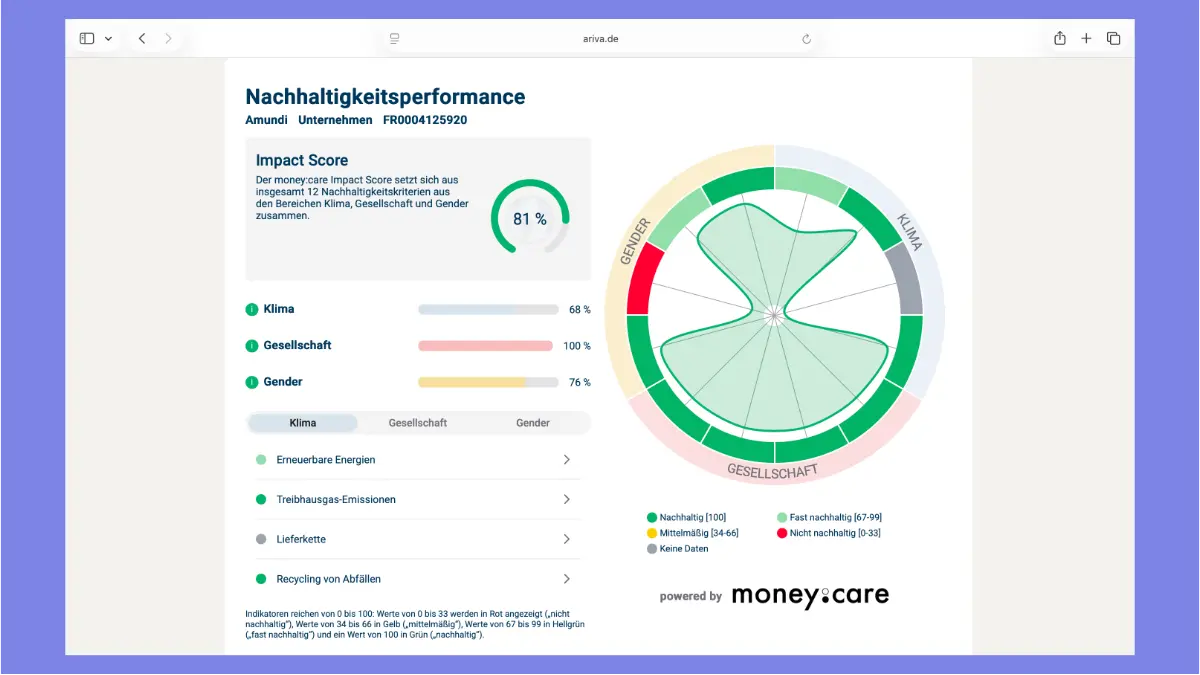
Each of our 12 indicators is equally weighted in the overall model. This means that anyone who uses our scores can understand which factors are included and to what extent. No black-box score, just an explainable number.
Level 4: Transparency Down to the Raw Data
Our scores can be traced back to the raw data. For each data point, we show which report and which page we sourced it from.
Furthermore, we place great emphasis on communicating our data in a user-friendly way.
What This Means for Integration into Financial Portals
For product teams integrating sustainability data into their platforms, three practical questions arise:
How do I explain the score to my users? An ESG score without context is a meaningless number. We provide a structured explanation for every score—what the target value is for the company and whether it has achieved it—displayed directly in the interface.
What happens when there are data gaps? Not every company provides complete reporting. Instead of filling in missing data with estimates, we explicitly flag these gaps. Users can see when a score is based on incomplete data—which is more honest than a seemingly complete value.
Where does the data come from? Each score can be broken down in as much detail as the user desires. Decisions can be made based on the overall score, the score in a specific category (climate, society, gender), or a specific indicator (e.g., women in management).
Trust is built through explainability
ESG data is becoming more relevant from a regulatory perspective, not less so. The EU Taxonomy, the CSRD, and upcoming MiFID requirements regarding investors’ sustainability preferences make data quality a must—not an option.
Financial portals that invest in explainable, verifiable ESG data today are building a competitive edge that will become relevant both regulatorily and competitively. And they are building trust among a user group that—according to a 2024 study by DZ Bank—cites sustainability as a criterion for platform selection in 58% of cases.
A score is only as good as the method behind it. We’ll show you ours.